At a glance
- The right plastic depends on the chemical, temperature, exposure time and mechanical demands.
- PTFE, PEEK, HDPE, UHMWPE and PET each suit different processing conditions.
- Always confirm chemical resistance for the exact substance and concentration involved.
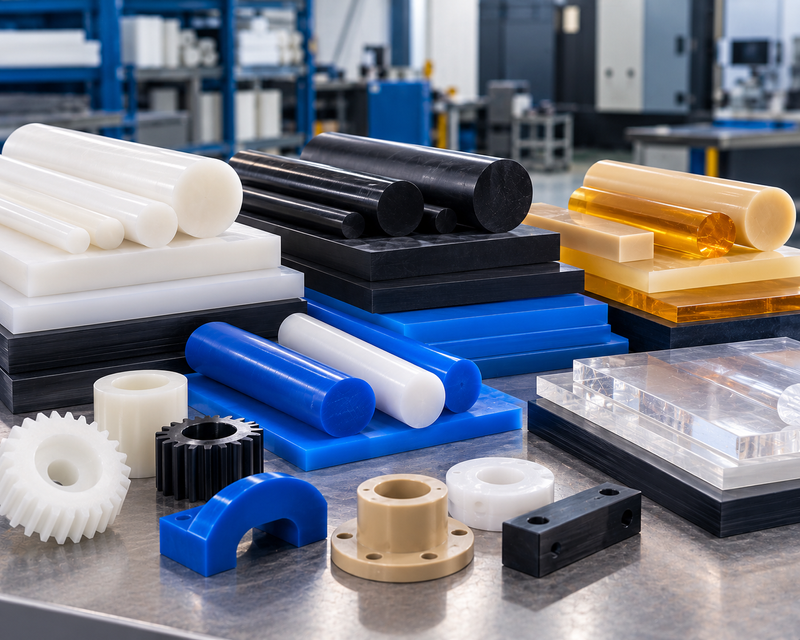
- Sheet works well for fabricated parts, while rod suits machined components and precision parts.
Processing equipment in chemical environments is constantly exposed to acids, alkalis, solvents, moisture and elevated temperatures, often alongside abrasive slurries or particulates. Components made from unsuitable materials can swell, soften, wear or deform after repeated contact with chemicals. This can lead to leaks, poor sealing or premature failure.
Engineering plastics are a suitable material option for many of these components. Depending on the grade, they can combine chemical resistance with low friction, impact resistance or temperature stability. This makes them suitable for pumps, valves, liners and precision parts.
No single engineering plastic suits every chemical-processing application. The right choice depends on the chemical involved, its concentration, the operating temperature and the mechanical demands on the part. Here’s how several engineering plastics used in chemical processing compare, and where each one fits best.
Best Engineering Plastic Materials for the Chemical Processing Industry
The following materials are among the most common engineering plastics for chemical processing. Each fits a different part of the system, from seals to structural components.
PTFE for Broad Chemical Resistance
PTFE is a fluoropolymer built around a strong carbon-fluorine backbone, which gives it resistance to a wide range of acids, alkalis and solvents. Few other engineering plastics match this breadth of chemical compatibility. Its surface is naturally low-friction and non-stick, which limits material build-up and reduces fouling during repeated chemical contact.
These properties make PTFE a well-established engineering plastic for sealing applications. You will often find it in seals, valve seats and pump components, where its non-stick surface reduces adhesion and helps maintain a consistent seal over time.
Chemically demanding, elevated-temperature environments suit PTFE better than applications requiring high structural strength, since it can be prone to creep under sustained mechanical load.
PEEK for High-Temperature, Load-Bearing Components
PEEK is a high-performance semi-crystalline thermoplastic that retains its mechanical properties under sustained heat and continuous mechanical stress. It combines chemical and hydrolysis resistance with notable strength, stiffness and dimensional stability, even in environments involving hot water or steam exposure alongside process chemicals.
This combination suits applications where your equipment faces chemical exposure and mechanical load at the same time. PEEK is commonly used for bearings, backup rings and bushes that must hold tight tolerances under pressure and heat.
Because it retains strength at higher temperatures than many other engineering plastics, engineers often choose it for components that would otherwise need frequent replacement in demanding duty cycles.
HDPE for General Chemical Handling
HDPE is a widely used semi-crystalline thermoplastic valued for its resistance to industrial chemicals, along with useful impact resistance and low moisture absorption. It is also easy to fabricate and weld into larger components, which makes it practical for equipment built on-site or in custom sizes.
This makes HDPE a practical choice for larger fabricated components used in chemical-processing equipment. You will typically see it used for tanks, covers, work surfaces and general containment equipment operating under moderate temperatures and loads.
UHMWPE for Chemical Exposure Combined with Abrasion
Ultra-high molecular weight polyethylene (UHMWPE) sits in a molecular weight range of roughly 3 million to 6 million. This long molecular chain gives it notable toughness against abrasion and impact, along with useful chemical resistance and a naturally low-friction surface.
Chemical resistance alone is not always enough for your equipment. When abrasive particles or slurries move alongside aggressive chemicals, UHMWPE is often selected for this combination.
Where it's typically used:
- Chute liners and hopper liners in bulk material flow.
- Scraper blades and wear strips under repeated contact.
- Guides in high-movement equipment.
- Available as UHMWPE sheets for liner fabrication and UHMWPE rods for machined wear components.
PET for Chemically Exposed Precision Components
Rigidity and chemical resistance to many oils, fuels, dilute acids and industrial solvents make PET a strong option for chemically exposed precision components. It also has low moisture absorption and low thermal expansion, which supports dimensional consistency across varying conditions.
These properties help PET hold its dimensions under chemical exposure and mechanical loading. If your components need to maintain tight tolerances, you can use PET for manifolds, filler pistons and wear pads operating at moderate temperatures. PET particularly suits applications where precise machining and repeatable part dimensions matter more than high-temperature performance.
Factors to Consider Before Selecting an Engineering Plastic
Choosing the right material goes beyond matching a plastic to a chemical name. A few practical factors should guide your decision.
- Chemical type and concentration: Identify the exact acid, alkali, solvent or process fluid involved. A general claim of chemical resistance does not confirm performance at your specific concentration.
- Operating temperature: Check both normal running temperatures and any temporary peaks. Heat spikes can soften or weaken a material even if it performs well under standard conditions.
- Exposure conditions: Consider whether contact is occasional, intermittent or continuous. Immersion, spraying and vapour exposure can each affect a material differently over time.
- Mechanical demands: Assess pressure, structural load, impact and abrasion alongside the dimensional tolerances the component must hold. Chemical resistance alone will not account for mechanical wear.
- Sheet or rod form: Choose sheet for liners, covers and fabricated parts, and choose rod for bushes, rollers, valve parts and other machined components.
The best engineering plastic for chemical processing depends on your application, the chemicals involved and your mechanical demands. PTFE offers broad chemical resistance, while PEEK performs under high temperatures and mechanical load. HDPE suits fabricated components, UHMWPE combines chemical and abrasion resistance, and PET supports precision-machined parts. Always confirm the exact chemical and concentration before selecting a grade.
As a trusted source for engineering plastics, ePOL supplies PTFE, PEEK, HDPE, UHMWPE and PET in sheet and rod form. Compare options and order online through our portal, without waiting on quotes or emails.
Contact us today to explore our range of engineering plastics.
FAQs
Do chemically resistant engineering plastics need protective coatings?
Not usually. Chemical resistance is generally an inherent material property, although a coating may be added when additional wear protection, surface performance or chemical isolation is required. You should still check compatibility for the exact chemical, concentration and temperature.
Can different engineering plastics be used in the same chemical-processing system?
Yes, different plastics can be selected for separate components based on their exposure, temperature, load, friction and wear requirements. Where two different plastics contact each other directly, such as a PTFE seal against a PEEK housing, you should also confirm they won't degrade, stain or react against one another over time.
Can engineering plastics replace metal components in chemical-processing equipment?
Yes, engineering plastics can replace metals in suitable components where corrosion resistance, lower weight or reduced friction is beneficial. However, the material must still withstand the required temperature, pressure and mechanical load. Understanding the advantages of plastics over metal can help identify suitable applications.
What should you check before buying engineering plastics online?
Check the material and grade, chemical compatibility, operating temperature, mechanical demands, dimensions and required sheet or rod form. Checking these factors upfront helps you avoid the wrong grade when buying engineering plastics online.