At a glance
- True machinability means producing accurate, clean parts, not simply being able to cut the plastic.
- Adequate stiffness and controlled heat response help prevent deflection, smearing and damaged edges.
- Dimensional stability allows a machined component to retain its shape and tolerances after processing.
- Acetal, PET, HDPE and PEEK suit different machining demands, so material selection must match the application.
Engineering plastics play a central role in modern manufacturing, valued for their strength, wear resistance and consistency across demanding applications. Yet you may assume that if a plastic can be cut, drilled or turned, it is automatically suitable for precision machining.
This is not always the case. Because engineering plastics are generally more elastic, retain heat longer and expand more than metals, they respond differently under cutting forces and heat exposure. A material poorly suited to the application can deflect, soften, produce difficult-to-manage chips or move outside the required tolerance during machining, affecting both accuracy and surface finish.
Understanding what separates a machinable plastic from one that simply tolerates cutting matters when you're working to tight specifications.
Below, we break down the properties that influence the machinability of engineering plastics and how different materials perform during common machining processes.
The Material Properties Behind Engineering Plastic Machinability
Several properties determine how predictably an engineering plastic responds during machining. Together, they explain what separates easy-to-machine plastics from those that merely tolerate cutting.
Sufficient Stiffness Under Cutting Loads
A machinable plastic needs enough rigidity to stay supported while it is clamped, turned, drilled or milled. Without sufficient stiffness, the workpiece can flex under the cutting tool, causing the finished component to move outside its intended dimensions during machining. This matters most on thin sections, long lengths or tight-tolerance components, where the material has less inherent support.
Reduced stability often brings vibration and deflection, which cause the workpiece to shift away from the cutting tool rather than hold its position. This tends to produce inconsistent dimensions, rougher edges or a weaker surface finish.
Materials that remain stable under tool pressure can hold tolerances more easily. For this reason, stiffness and dimensional stability are considered key indicators of readily machinable plastic stock.
Controlled Response to Machining Heat
Heat behaves differently in engineering plastics than in metals. Because they conduct heat away from the cutting area more slowly, friction generated during machining tends to build up locally rather than dissipating through the material. As a result, the cutting point is more likely to experience localised overheating.
A suitable softening temperature makes a plastic less likely to melt, smear or develop heat-damaged edges when machined correctly. Thermal expansion matters too, since plastics expand more than metals as they warm. A material with lower, more predictable expansion holds its dimensions more consistently, which helps distinguish plastics that machine reliably from those that become prone to distortion as heat builds up.
Read More: The Difference Between Mechanical, Thermal and Electrical Properties of Engineering Plastics
Good Dimensional Stability
Moisture is easy to overlook, but it can affect the machining result. Plastics that absorb moisture may swell before machining or shift after cutting, enough to move a finished part outside tolerance. Materials with low moisture absorption hold their size more consistently across storage, machining and end use.
- Dimensional stability differs from stiffness, since a plastic can resist tool pressure but still move afterwards due to moisture or stress release.
- Dimensional movement can occur during machining itself, or only become noticeable once the component has settled afterwards.
- Tight-tolerance parts and thin or complex geometries are more sensitive to dimensional changes during machining than simple, thicker sections.
Residual stress introduced during sheet or rod manufacture can have a similar effect. Once material is removed during machining, that stress can release unevenly and cause the component to warp rather than remain flat. Lower residual stress means less movement, helping the finished part hold its flatness, roundness and tolerances after leaving the machine.
Balanced Toughness and Hardness
The cutting edge applies sudden, concentrated force to a small area of material, so a plastic needs enough toughness to absorb that force without cracking or chipping. Materials that are too brittle can fracture unpredictably at the point of contact, which leaves chipped edges rather than a clean cut.
Hardness plays a complementary role at the same cutting edge, allowing the tool to shear material cleanly rather than push, stretch or smear it. The most easily machined engineering plastics are rarely the softest or hardest available. A practical balance between toughness and hardness tends to produce cleaner cuts and more predictable results.
Choosing the Right Engineering Plastic for Machining
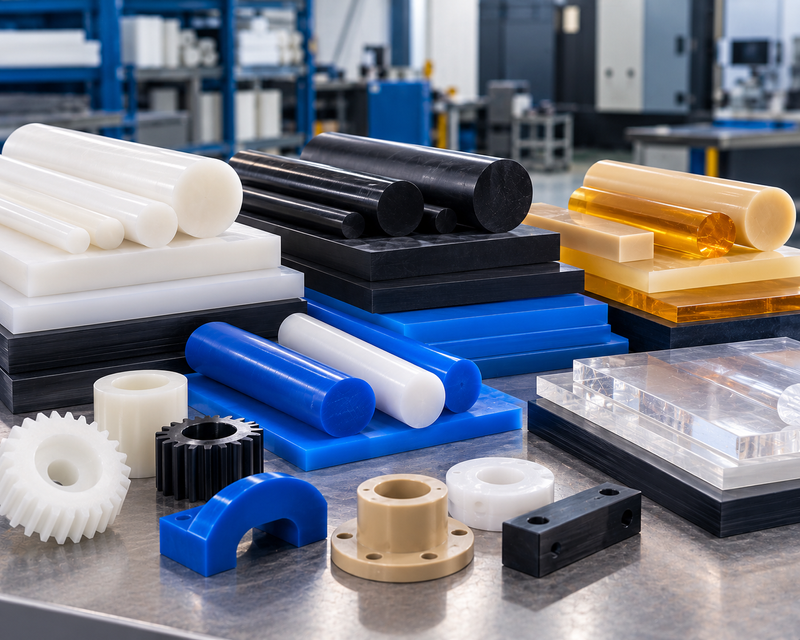
How a plastic balances stiffness, heat response, dimensional stability and toughness determines how easily it machines in practice. The materials below show how that balance plays out differently across common engineering plastics.
- Acetal: Acetal tends to be the material engineers choose when a part must not move. Its combination of high stiffness, low moisture absorption and strong dimensional stability keeps machined features consistent, even across tight tolerances. For precision components, engineers often treat it as a reference point for machinability.
- PET: Where a component needs to hold its shape more than capture fine detail, PET is a suitable choice. It cuts and machines cleanly, offering good rigidity and dimensional performance across straightforward geometries. Acetal generally proves easier to work with once designs become more intricate, but PET still performs well for shape retention.
- HDPE: HDPE machines easily for parts where tolerances are not the main concern, and most workshops find it forgiving to cut and shape. Its lower stiffness is the trade-off, since the workpiece can flex under tool pressure without adequate support. It suits simpler components rather than precision work with tight dimensional demands.
- PEEK: PEEK is usually reserved for components that need to perform under demanding heat or load conditions, not simply meet a tight dimension before being put into use. Its high stiffness, mechanical strength and dimensional stability support machining to close tolerances. However, its heat response and residual stress require more careful process control than a general-purpose plastic such as acetal.
Machinability depends on how a plastic balances stiffness, heat response, dimensional stability and toughness under the demands of cutting, drilling or turning. No single engineering plastic performs best across every application, since the right choice depends on the component's tolerances, geometry and operating conditions.
Acetal, PET, HDPE and PEEK each strike this balance differently, and understanding how each material performs helps predict how consistently it will hold its shape and finish once it leaves the machine.
For engineers and fabricators comparing machinable plastic stock, ePOL's online portal makes it easier to check specifications and order the required sheets or rods for your project. Comparing options before ordering helps match the material to the tolerances and finish that your component demands.
Get in touch with us today to choose an engineering plastic that machines reliably for your application.
FAQs
Can filled or fibre-reinforced engineering plastics be machined with standard tools?
Yes, many filled or fibre-reinforced engineering plastics can be machined using conventional equipment. However, abrasive glass or carbon fibres can wear high-speed steel tools quickly, so carbide or diamond-tipped tooling may be required for consistent accuracy and surface finish.
How tight can machining tolerances be with engineering plastics?
For highly stable engineering plastics like PEEK and Acetal, you can achieve machining tolerances as tight as ± 0.01 mm (± 0.0005 inches) under strictly controlled conditions. However, standard practice for plastic CNC machining typically ranges between ± 0.05 mm and ± 0.13 mm, depending heavily on the material and part geometry.
Can machined engineering plastics replace metal components?
Yes, machined engineering plastics can replace metals where lower weight, corrosion resistance, low friction or electrical insulation is required. The right choice depends on the component’s load, temperature, wear and operating environment. Read more on different materials that can be replaced by engineering plastics.
What should you consider before ordering engineering plastic for machining?
Consider the required material and grade, sheet or rod dimensions, finished-part tolerances, operating conditions, quantity and machining allowance. Providing these details helps ensure you order the correct stock size and avoid unnecessary material removal, as explained in this guide to buying engineering plastics online.