At a glance
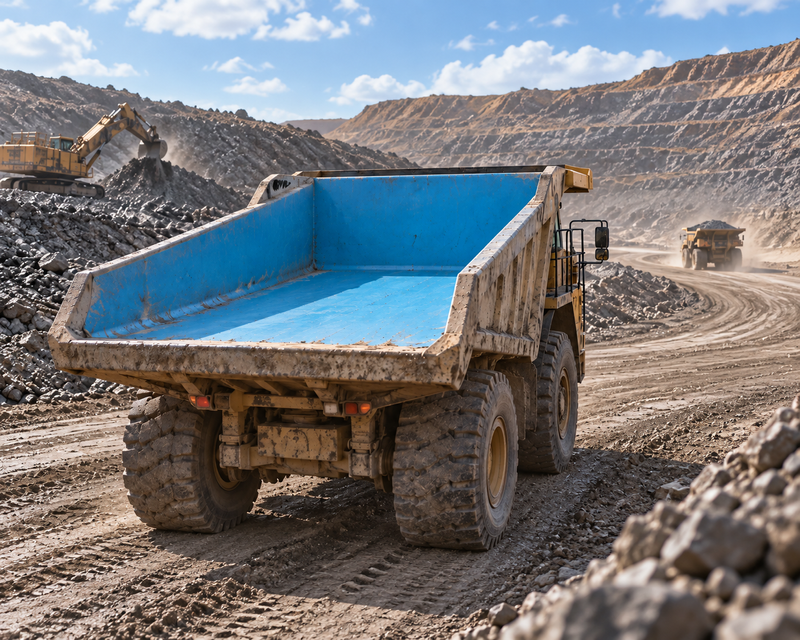
- UHMWPE bed liners protect truck body steel from abrasive loads like gravel, ore and demolition waste.
- A low-friction surface reduces load sticking and speeds up unloading.
- UHMWPE is non-absorbent and resists many chemicals, helping avoid rust and corrosion issues common with metal liners.
- The right thickness and fit strongly influence how long a UHMWPE liner lasts in service.
Not all engineering plastics are suited to liner applications. The right option needs to resist abrasion, handle repeated impact, release bulk loads and withstand chemical exposure.
UHMWPE (Ultra High Molecular Weight Polyethylene) is one of the few engineering plastics that meet all of these requirements. It delivers exceptional wear resistance, high impact strength and a very low-friction surface that supports smooth material flow even under heavy load.
That combination has made UHMWPE a popular choice for truck and trailer bed liners across mining, construction, agriculture and bulk transport. Since the liner surface has a direct impact on equipment lifespan and maintenance demands, getting it right from the start matters.
Below, you'll find the properties that make UHMWPE one of the most effective options for truck and trailer bed liners, along with the key factors to weigh up before choosing it.
What Makes UHMWPE Well-Suited to Truck and Trailer Bed Liners?
UHMWPE performs reliably across demanding transport and industrial environments, which is why it's used so widely for liner applications. Here are some of the key characteristics that make UHMWPE ideal for truck and trailer bed liners:
Exceptional Abrasion Resistance Extends Bed Life
Truck and trailer beds are in constant contact with some of the most abrasive payloads in the industry. Gravel, demolition waste, ore, sand and aggregates all carry sharp edges that gradually cut into exposed surfaces with every load. Without adequate protection, the steel structure underneath deteriorates faster than it should.
Wear-resistant UHMWPE liners act as a protective layer between the load and the steel. In practical terms, think of a tipper truck making daily hauls of crushed rock on a construction site. With an unprotected steel bed, surface scoring becomes visible within months. A UHMWPE liner takes that wear instead, protecting the underlying structure and extending the body's working life.
Swapping out a liner is far cheaper than repairing or replacing a truck body, making lining system selection as much a maintenance decision as a performance one.
Low Friction Properties Promote Faster Load Release
UHMWPE has a naturally low coefficient of friction, which means bulk products slide across its surface with less resistance. In comparison, steel can grip and hold wet or compacting loads, while rubber often creates suction-like adhesion with sticky loads. UHMWPE allows bulk loads to move and release more easily during discharge. That difference becomes noticeable quickly in everyday operations.
This is especially important when transporting wet, sticky or fine-grained materials that cling to bed surfaces. UHMWPE performs reliably in wet and humid conditions, helping maintain its low-friction properties even when loads arrive saturated.
Smoother discharge reduces the time spent clearing leftover material from the bed after each unloading cycle, which adds up to real savings across daily bulk material handling operations.
Did you know?
UHMWPE has a coefficient of friction as low as 0.10–0.15 against steel, helping improve material flow and reduce sticking.
High Impact Strength Withstands Heavy Loading Conditions
Loading a truck bed is often a high-impact process. Excavators drop buckets of rock, loaders tip heavy contents from height and bulk loads land with significant force across the bed surface. A liner product that cracks, chips or fractures under repeated impact creates its own maintenance problem and leaves the steel beneath exposed.
UHMWPE spreads out impact energy rather than passing it straight to the surface, so it withstands heavy loading. This toughness is especially important in mining, quarrying and construction, where constant loading cycles would quickly wear down a less durable grade. For operations running multiple shifts, that reliability reduces unplanned downtime caused by liner damage.
Moisture Resistance Prevents Material Build-Up
Moisture can make it more challenging to unload certain load types. Wet soil, clay, silage and fine aggregates often stick to liner surfaces, causing build-up that slows unloading and increases cleanout requirements. Since UHMWPE does not absorb water, it keeps a smooth, consistent surface even in wet conditions, making it easier for the payload to release from the bed.
Rubber can cause sticky or compacted loads to cling to the liner surface, while aluminium offers less natural slip. UHMWPE helps prevent loads from adhering to the liner surface in either case. This is especially useful in waste-handling industries, where materials are often exposed to moisture and changeable weather during transport.
Key considerations:
- Reduces the risk of wet products freezing onto the liner surface in cold conditions
- Helps maintain more predictable unloading performance throughout the year
- Minimises the amount of residue left behind after discharge
Chemical and Corrosion Resistance Supports Long-Term Performance
Truck and trailer liners do not always carry clean, inert aggregates. Fertilisers, mining chemicals, road salts, waste slurry and agricultural by-products all introduce chemical exposure that can degrade liner surfaces over time. For metal surfaces in particular, that exposure accelerates corrosion and shortens the effective service life of the liner.
UHMWPE resists a wide range of chemicals without surface degradation, which is why it holds up so well across diverse material handling applications. In agricultural transport, for example, a vehicle carrying liquid fertiliser residue or wet organic waste repeatedly exposes the trailer bed to corrosive conditions.
A UHMWPE liner holds up well in these conditions without pitting, rusting or softening like metal or some rubber compounds can. That resistance supports longer service life and reduces the replacement frequency across a working fleet.
Factors to Consider When Selecting a UHMWPE Bed Liner
While UHMWPE offers excellent performance characteristics, choosing the right liner involves more than selecting the plastic itself. A few practical factors can make sure the liner offers the durability, protection and lifespan needed for a specific application.
- Liner Thickness: The right UHMWPE sheet thickness should reflect the severity of the application rather than defaulting to a standard size. A truck carrying abrasive quarry products will place very different demands on a liner than one transporting grain or fertiliser. Matching thickness to wear levels helps ensure the liner provides adequate protection without adding unnecessary weight or cost.
- Truck or Trailer Configuration: No two truck or trailer bodies are exactly alike, and liner performance often depends on how well the system fits the equipment. Body shape, dimensions and unloading method all affect discharge flow and wear patterns. That is why purpose-designed liner systems such as OKUSLIDE® are developed to suit different truck and trailer configurations. They help you get the most out of UHMWPE's performance benefits, even in the most demanding settings.
Read More: Why Do Operators Choose OKUSLIDE® UHMWPE Bed Liners?
- Operating Environment: The conditions surrounding the application can be just as important as the material being transported. Regular exposure to moisture, temperature extremes or chemicals may influence which UHMWPE grade is most suitable. Taking these factors into account keeps performance consistent throughout the liner's service life.
- Installation Quality and Fitment: Even a high-quality liner can fall short if it's installed incorrectly. A proper fit keeps the liner secure through repeated loading and unloading. It also protects the vulnerable areas of the truck or trailer bed. Careful installation has a big impact on long-term durability and reliability.
UHMWPE is highly effective in truck and trailer bed liner applications, as its properties align with the demanding conditions these liners face. Abrasion resistance and impact strength protect the truck body structure. Low friction and moisture resistance support cleaner, faster discharge. Chemical resistance reduces surface degradation over time. Together, these characteristics add up to a longer service life and steadier performance, even in high-wear transport environments.
The selection of the right liner ultimately depends on the application. How well a liner performs in practice comes down to getting the thickness, configuration, environment and installation right. These details are what separate adequate performance from reliable, long-term durability.
For industrial buyers sourcing truck and trailer liner materials, ePOL's online portal makes it straightforward to compare UHMWPE products, check stock levels and place orders. As a reliable engineering plastics supplier, we provide the materials and product information needed to support informed procurement decisions without unnecessary delays.
Get in touch with our team to source a UHMWPE solution for your application.
FAQs
How does temperature affect the performance of a UHMWPE bed liner?
UHMWPE performs well across a reasonable working temperature range and is commonly used in both cold and moderately warm operating environments. In freezing conditions, its non-absorbent surface helps prevent wet materials from bonding to the liner. At elevated temperatures, performance can be affected depending on the load and operating conditions.
Can UHMWPE bed liners be repaired or replaced if they become damaged?
Yes. Minor surface wear may not require immediate replacement, but deeper cuts, loose sections or heavily worn areas should be assessed and replaced if needed.
How does UHMWPE plastic perform compared to other engineering plastics?
UHMWPE stands out for its combination of abrasion resistance, low friction and impact strength. Materials like Acetal and Nylon offer better machinability and dimensional stability, but do not match UHMWPE in wear performance under sliding contact. Read more on UHMWPE vs other engineering plastics.
Is UHMWPE suitable for use in the food industry?
Yes. Its non-absorbent surface, resistance to moisture and lack of plasticisers mean it won't contaminate food contact surfaces, making it suitable for food-grade use.